Sutasoma Jataka
The Tale of Prince Sutasoma and the Fearless Ascetic
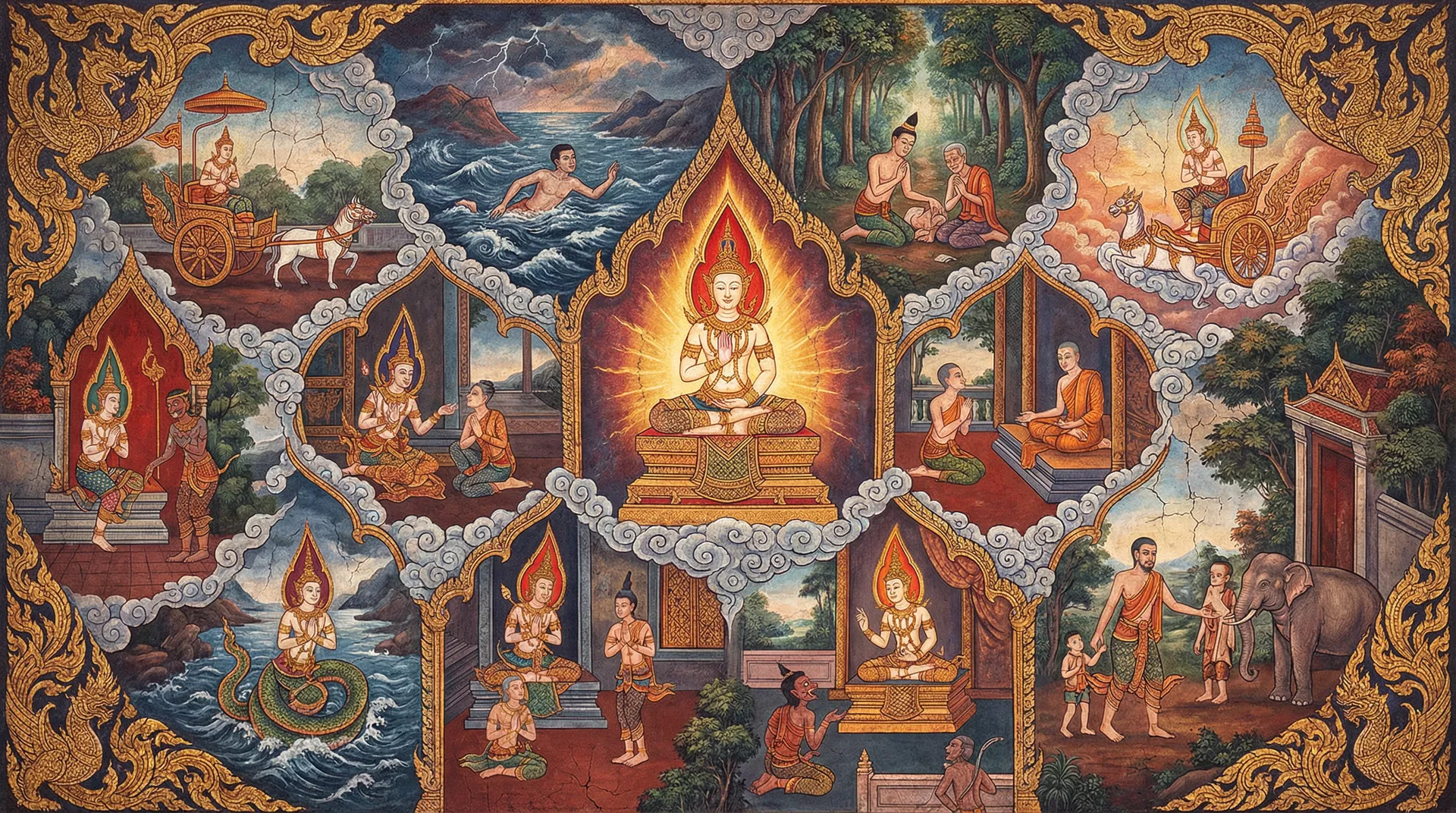
In the vibrant city of Gandhara, ruled King Piliya. He had a son named Sutasoma, a prince of great intelligence and virtue. However, King Piliya harbored a dark secret: he was a cannibal, driven by an insatiable craving for human flesh. He would hunt and devour unsuspecting travelers, his secret known only to his most trusted, and terrified, servants.
Prince Sutasoma, though aware of his father's vile deeds, was bound by filial duty. He longed to put a stop to his father's atrocities, but he feared the consequences of directly confronting the king. He spent his days in quiet contemplation, seeking a way to resolve this terrible dilemma.
One day, a young ascetic named Nandiya arrived in Gandhara. He was a man of extraordinary courage and wisdom, who practiced a life of extreme austerity and compassion. He wandered fearlessly, unafraid of any danger, his mind filled with an unwavering resolve to uphold righteousness.
Prince Sutasoma, hearing of the ascetic's fearlessness, was deeply impressed. He sought him out, and after respectfully greeting him, he confided in him about his father's cruel nature and his own predicament. "Venerable sir," Sutasoma said, his voice heavy with anguish, "my father, the king, commits terrible acts, preying on innocent people. I am torn between my duty as a son and my desire to protect the innocent. I do not know how to end this suffering."
Ascetic Nandiya listened intently, his gaze calm and steady. When Sutasoma finished, Nandiya declared, "Prince, I will go to your father and speak with him. I will offer myself as a sacrifice to end this cycle of violence."
Sutasoma was aghast. "No, venerable sir! You must not! That would be a terrible loss!"
Nandiya replied with a gentle smile, "Fear not, Prince. My life is dedicated to the well-being of all beings. If my sacrifice can bring an end to such wickedness and save countless lives, then it is a sacrifice gladly made. True courage lies not in the absence of fear, but in acting righteously despite it."
Despite Sutasoma's pleas, Nandiya remained resolute. He went to the palace and requested an audience with King Piliya. The king, intrigued by the ascetic's unusual request, granted him entry.
"Great King," Nandiya began, his voice clear and unwavering, "I have heard of your prowess. I have come to offer myself as a meal for you, to test your strength and to bring an end to the suffering of your subjects. If you can devour me, then my life's purpose will be fulfilled."
King Piliya, accustomed to terrorizing the weak, was taken aback by the ascetic's audacious offer. He saw no fear in Nandiya's eyes, only a profound peace and a quiet strength. Intrigued and perhaps a little unnerved, the king agreed.
As the king prepared to consume the ascetic, Nandiya began to speak, not of his own virtue, but of the consequences of his father's actions. He spoke of the pain of the victims, the fear that gripped the land, and the karmic repercussions of such deeds. He spoke with such compassion and wisdom that King Piliya, for the first time, felt a pang of remorse. The ascetic's fearless sincerity and his willingness to sacrifice himself for the sake of others shook the king to his core.
In that moment, King Piliya's heart underwent a profound transformation. He saw the error of his ways, the monstrousness of his actions. He laid down his weapons and wept. "Ascetic," he cried, "you have shown me the truth! Your courage and selflessness have opened my eyes. I renounce this wicked path forever!"
He vowed to never again harm a living being. Prince Sutasoma, overjoyed and relieved, embraced the ascetic. The kingdom rejoiced at the king's repentance and the end of his terrifying reign of terror.
Ascetic Nandiya, having achieved his goal through his extraordinary courage and compassion, continued his journey, leaving behind a kingdom transformed by the power of righteous action and fearless love.
— In-Article Ad —
💡Moral of the Story
True courage lies in acting with righteousness and compassion, even in the face of great danger. Selfless sacrifice and unwavering conviction can inspire profound transformation and end suffering.
Perfection: Courage (Virya)
— Ad Space (728x90) —
More Jataka Tales You May Enjoy
 299Tikanipāta
Mahosadha Jataka
The Mahosadha Jataka: The Wise Minister Mahosadha In the ancient kingdom of Videha, ruled by the jus...
💡 Wisdom, clarity of thought, and foresight are the most powerful tools for solving problems, dispensing justice, and ensuring the prosperity and peace of a kingdom. True leadership lies in intelligent and ethical decision-making.
 76Ekanipāta
The Tale of the Fragrant Tree
The Tale of the Fragrant Tree In the heart of a vast and ancient forest, where sunlight dappled thr...
💡 Curiosity, coupled with the courage to learn new things, can lead to great discoveries that benefit society.
 175Dukanipāta
Nimi Jātaka
Nimi JātakaIn the ancient and prosperous kingdom of Mithila, there reigned a virtuous king named Nim...
💡 Actions have consequences, both in this life and in the next. Virtuous deeds lead to happiness and celestial rewards, while unwholesome actions result in suffering. Living a life of righteousness is the path to true and lasting fulfillment.
104EkanipātaKacchapa Jātaka
The Turtle King's Steadfastness Far away, in a land graced by lush greenery and clear blue skies, th...
💡 Upholding one's principles and integrity is more valuable than any shortcut or material gain. True strength and resilience come from steadfastness in the face of adversity and the courage to choose the honest path.
83EkanipātaSihaccha Jātaka
Sihaccha Jātaka In the ancient city of Vārāṇasī, there lived a king named Dhṛtarāṣṭra, a ruler known...
💡 Pride can blind us to wisdom. True strength lies in humility and the willingness to learn from others, regardless of their status or perceived intelligence.
105EkanipātaSasa Jātaka
The Hare Who Gave His Life In the ancient times, when the moon was young and the stars shone brighte...
💡 Selfless generosity, even to the point of sacrificing one's own life, is the highest virtue. True compassion extends beyond oneself and seeks to alleviate the suffering of others at any cost.
— Multiplex Ad —